North of Ellenville was Napanoch, soon to be 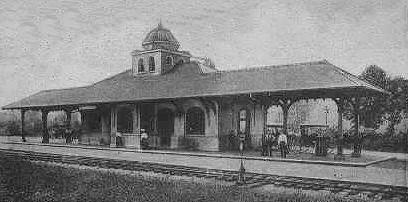 the site of the State Reformatory
and another one-way passenger destination, though not for the
same type of vacation.
the site of the State Reformatory
and another one-way passenger destination, though not for the
same type of vacation.
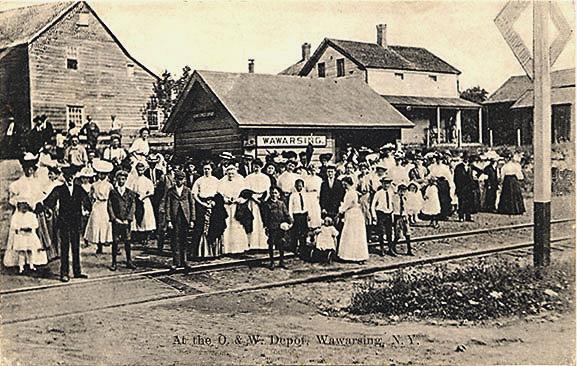 Further
north was the rustic station at Wawarsing. Again, resort business
kept this station alive. Notice the higher elevation at the back
of the station, necessitating
the shortened eave overhang. The station, surrounded by trees,
still survives. (Photo courtesy Bruce Tracy) In its early
years, the O&W used Adams
Express Company for express shipments. During World War I,
express
Further
north was the rustic station at Wawarsing. Again, resort business
kept this station alive. Notice the higher elevation at the back
of the station, necessitating
the shortened eave overhang. The station, surrounded by trees,
still survives. (Photo courtesy Bruce Tracy) In its early
years, the O&W used Adams
Express Company for express shipments. During World War I,
express 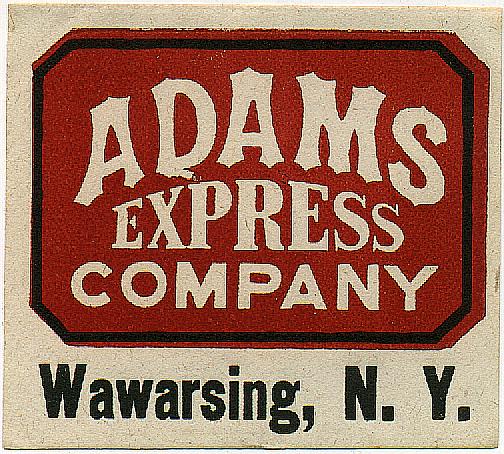 companies
were combined into Railway Express. However, this Adams Express
sticker, which would have been pasted onto a package to identify
its station of origin, survives.
companies
were combined into Railway Express. However, this Adams Express
sticker, which would have been pasted onto a package to identify
its station of origin, survives.
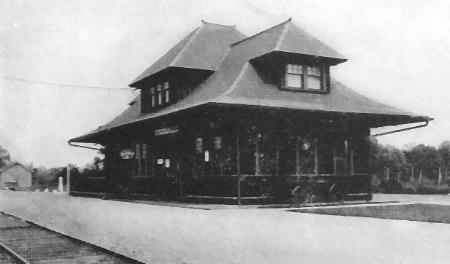
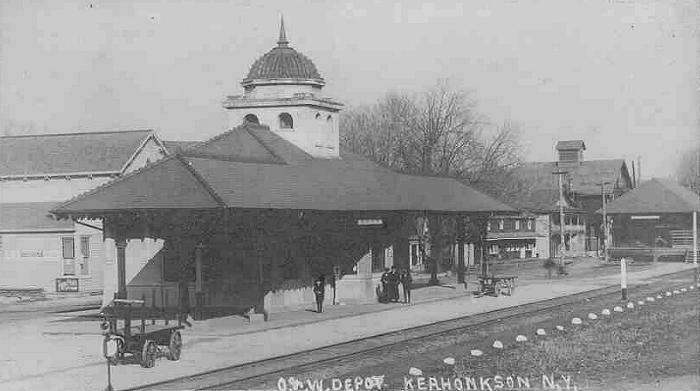 The
Kerhonksen station was
similar in design to the Napanoch station. The mission
style and the cupola
made these two stations unique. By the late 1960s, all that was
left in Kerhonksen was
The
Kerhonksen station was
similar in design to the Napanoch station. The mission
style and the cupola
made these two stations unique. By the late 1960s, all that was
left in Kerhonksen was 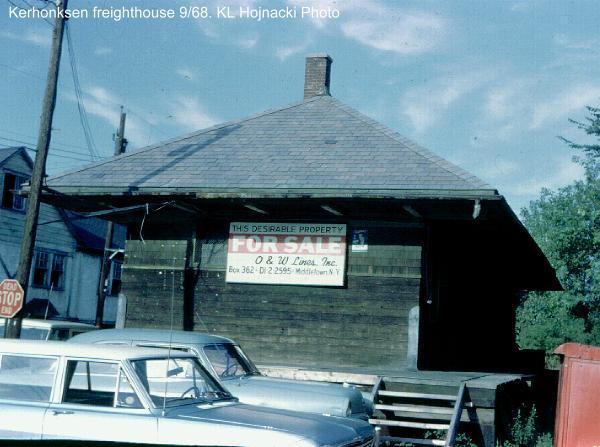 freighthouse searching for a buyer. After
the railroad was closed, a company called O&W Lines was created
to sell off the remaining real estate assets. It was headquartered
in the Middletown station building and lasted over a decade after
the demise of the railroad it was named for.
freighthouse searching for a buyer. After
the railroad was closed, a company called O&W Lines was created
to sell off the remaining real estate assets. It was headquartered
in the Middletown station building and lasted over a decade after
the demise of the railroad it was named for.
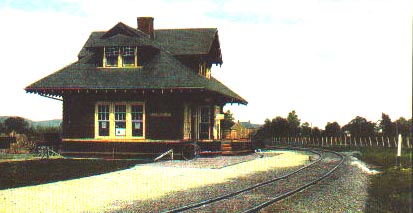 Accord
was a busy station north of Ellenville. For more on Accord and
agent Mike Palmer, stop by the ACCORD
page.
Accord
was a busy station north of Ellenville. For more on Accord and
agent Mike Palmer, stop by the ACCORD
page.
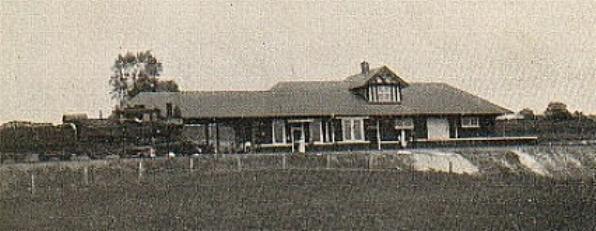 High
Falls was the next stop, up on a hill above the road underpass.
After being a farm implement dealership, the station
is now a private residence.
High
Falls was the next stop, up on a hill above the road underpass.
After being a farm implement dealership, the station
is now a private residence.
 The
Kingston Branch followed the old D&H Canal and, in fact, snubbing posts from the
old canal were often used as mileposts, as seen here in Cottekill.
The
Kingston Branch followed the old D&H Canal and, in fact, snubbing posts from the
old canal were often used as mileposts, as seen here in Cottekill.
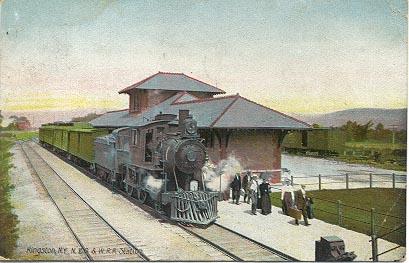 Kingston
was the end of the line. Passengers could change trains
with the Ulster & Delaware or the New York Central's West
Shore route. This train appears
to be waiting to depart southbound. The freight house, also a
brick building, is seen behind the station to the left. Both buildings were demolished around
1968 during the expansion of US Route 209.
Kingston
was the end of the line. Passengers could change trains
with the Ulster & Delaware or the New York Central's West
Shore route. This train appears
to be waiting to depart southbound. The freight house, also a
brick building, is seen behind the station to the left. Both buildings were demolished around
1968 during the expansion of US Route 209.
Former Oswego Midland locomotive #50, "Weehawken," a Baldwin product of 1872, is seen with a work train in Kingston on November 22, 1902. The car immediately behind the engine appears to be a flanger, possibly being used to regulate the ballast between the newly-laid rails which completed the branch.
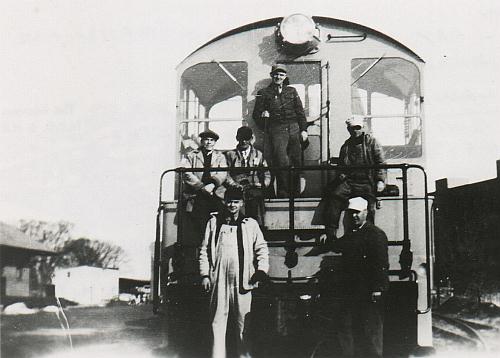 The
crew of the local pauses in its chores at Kingston to have their
portrait taken in March, 1948. The freight house appears to be
the building in the left background. Standing on footboards, l
to r: Railway Express Messenger Ray Wilbur, Fireman Ken Benjamin.
On engine, l to r: Conductor James Morgan, Brakeman Ray Whinne,
Engineer Frank Weyrauth and Flagman Harry T. Horton.
The
crew of the local pauses in its chores at Kingston to have their
portrait taken in March, 1948. The freight house appears to be
the building in the left background. Standing on footboards, l
to r: Railway Express Messenger Ray Wilbur, Fireman Ken Benjamin.
On engine, l to r: Conductor James Morgan, Brakeman Ray Whinne,
Engineer Frank Weyrauth and Flagman Harry T. Horton.
| Back to Kingston Branch Page 1 | Back to O&W Main Page |


